In this article, I will introduce you to one of the most fundamental components in electronics that is the resistor.
Resistors are essential building blocks in almost every electronic circuit. You cannot imagine any electronic device that does not use resistors. Their primary job is to control the flow of current, protect sensitive components, and prevent devices from overheating or burning out. In simple words, resistors silently ensure that our gadgets work safely and reliably.
This article will also explore different types of resistors, including the importance of the colour bands and how they are used to calculate a resistor’s value. You will also learn how to choose the right resistor for your circuit design.
I hope you find this guide helpful and that it improves your understanding of how resistors keep electronic systems safe, stable, and working properly.

What Is a Resistor?
A resistor is one of the most fundamental components in electronics. Its main job is to limit or control the flow of electric current in a circuit. Since it doesn’t add energy or perform any active function, it is known as a passive component.
A resistor allows only a certain amount of current to pass through it. It does not store energy; instead, the electrical energy associated with the current is converted into heat. This is why resistors often warm up during operation.
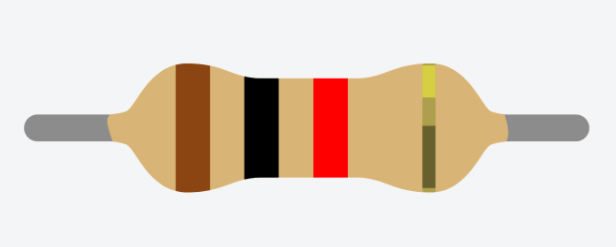
Resistors do not generate power; they only dissipate it. This simple characteristic makes them extremely important in electronic design. They help in:
- Controlling voltage levels
- Limiting current to protect components
- Setting bias points in circuits
- Shaping and filtering electrical signals
Because of these functions, resistors are found in almost every electronic device—from mobile phones to power supplies to microcontroller boards.
Why Do We Need Resistors?
To understand resistors, imagine water flowing through a pipe:
- Voltage = Water pressure
- Current = Flow of water
- Resistor = A narrowing in the pipe
When a pipe becomes narrower, less water can flow through it. A resistor works in the same way; it limits the amount of electric current that can flow in a circuit.
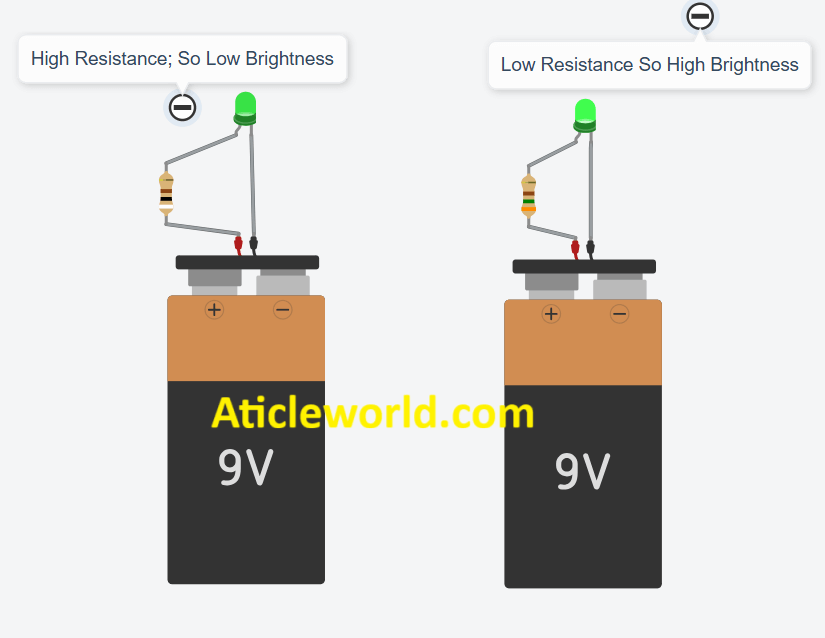
Let’s break it down with real-life examples.
1. Protecting Components from Damage:
Many electronic parts—like LEDs, sensors, transistors, and microcontrollers—can handle only a small amount of current.
Example: LED Without a Resistor
A typical LED needs only 10–20 mA. If you connect it directly to a 5V supply without a resistor, the current may rise to hundreds of mA.
Result:
- The LED burns immediately.
- The power supply may also get damaged
Why?
- Because the LED provides almost no resistance.
- Without a resistor, too much current flows through it → it overheats → burns.
Fix issue with a Resistor:
- Adding a resistor limits current to a safe level (e.g., 15 mA).
- This is why every LED circuit uses a resistor.
2. Controlling or Reducing Voltage:
Resistors can also divide voltage using a voltage divider. For example, if you have a 9V supply but your sensor needs only 3.3V, two resistors can be used to bring the voltage down safely. Without them, the sensor would receive too much voltage and could be damaged.
3. Setting Bias in Transistors or Amplifiers:
Transistors need a specific voltage and current to operate properly. This operating point is called bias.
Example: Biasing a transistor
A resistor helps keep the transistor in the correct region of operation—
- Not fully ON
- Not fully OFF
- Just the right amount of conduction for stable amplification
Without the resistor, the transistor could drift into the wrong region and behave unpredictably, leading to distortion or malfunction.
4. Shaping and Filtering Signals
Many electronic circuits: such as audio systems, sensor circuits, and communication devices—need clean and stable signals. Resistors play a key role in shaping and filtering these signals.
Example: Removing noise using an RC filter
A resistor combined with a capacitor forms an RC low-pass filter. This filter:
- Removes unwanted high-frequency noise
- Allows the important, low-frequency part of the signal to pass
- Keeps the output smooth and clean
Without resistors, essential filtering and signal conditioning would not be possible.
5. Setting Safe Current for Charging
Even battery chargers rely on resistors (or resistor-based circuits) to control and limit charging current.
Example: Charging a small Li-Ion cell
Charging a Li-Ion battery too quickly can cause overheating, swelling, or permanent damage. A resistor helps keep the charging current within a safe and controlled limit, ensuring the battery charges smoothly without stress.
6. Pull-Up and Pull-Down Resistors (MCU Pin Stabilization)
Digital input pins on MCUs can “float” if not tied to a definite logic level. A pull-up or pull-down resistor forces the pin to a stable state.
Real-world uses:
- I2C lines (SDA, SCL) use pull-ups
- Reset pin requires a pull-up
- Buttons use pull-up/pull-down to eliminate random noise
Firmware behaves incorrectly if these resistors are missing—false triggers, unexpected resets, and glitches.
How Do Resistors Work?
A resistor may look like a small and simple component, but inside an electronic circuit it plays one of the most important roles: controlling the flow of electrical current. Now, you already know this 😊.
To understand how it works, let’s break it down in a clear but technically accurate way.
What Really Happens Inside a Resistor?
When you apply a voltage across a resistor, electrons begin to move through its material. This movement of electrons is called electric current. But resistors are made from materials like carbon, metal film, or metal alloy, which do not allow electrons to move freely.
Inside the resistor:
- Electrons collide with atoms in the material.
- These collisions slow down the electrons.
- The lost energy turns into heat.
This opposition to the electron flow is known as resistance.
This simple behavior is described by Ohm’s Law:
I = V / R
If you increase the resistance “R”, the total current “I” decreases.
That means,
- Higher resistance → less current
- Lower resistance → more current
This is the core principle behind how every resistor works.
Why Do Resistors Get Hot?
Every time an electron collides with an atom inside the resistor, it loses a small amount of energy. That energy is released as heat.
This is why resistors have a power rating like 0.25W, 0.5W, 1W, etc.
Choosing the correct power-rated resistor prevents overheating and protects your circuit.
Learn to Work with Resistors:
When you first play with electronics, resistors look like tiny colored sticks scattered everywhere. You don’t really notice them until you connect an LED straight to a battery and it burns out. That is when you realize: electricity needs to be controlled, not assumed.
A resistor’s job is simple but critical. It sets the exact amount of current a component is allowed to take. Every LED, sensor, and transistor depends on this control.
And the tool you use every single day to size a resistor is Ohm’s Law:
V = I x R
Here,
- “V” is the voltage.
- “I” is the current.
- “R” is the resistance.
𝑅 = 𝑉 / 𝐼 → tells you what resistor you need to keep things safe.
Once you start using this rule, resistors stop feeling random. They become the tool that lets you protect, balance, and shape every circuit you build.
Resistors in Series:
When you connect resistors one after another in a straight line, they are said to be in series.
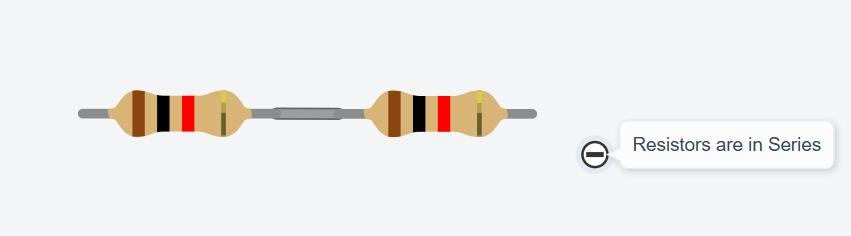
In this setup, the electric current has only one single path, so it must flow through every resistor one by one.
The key idea is very simple:
👉 Resistances in series add up: Rtotal = R1+R2+R3+…
Why is this useful?
Because once you know the total resistance, you can easily use Ohm’s Law to find the current in the circuit. Series connections are commonly used when you want to:
- Increase the overall resistance.
- Drop or share voltage across multiple components.
- Protect sensitive parts by slowing down the current more gradually
So, you can think of resistors in series as multiple “speed breakers” placed one after another — together, they make it harder for current to flow.
Resistors in Parallel:
When resistors are connected side-by-side and both ends are tied to the same two points, they are said to be in parallel.
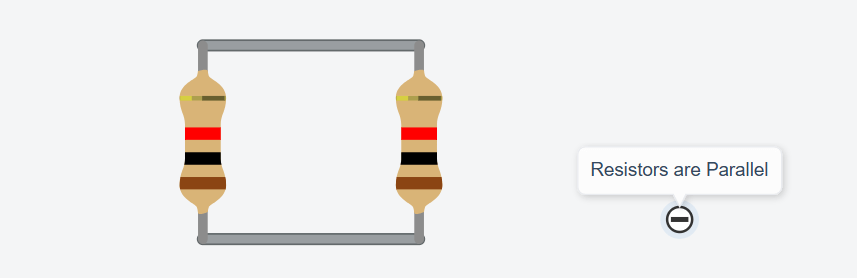
You can imagine it like multiple lanes on a highway. The voltage across each lane is the same, but the current can split and choose different paths. In a parallel connection, the total resistance becomes smaller.
The formula for total resistance is:
1/ Rtotal = 1/ R1 + 1/ R2 + 1/ R3+…
For just two resistors, an easy shortcut is:
Rtotal = (R1 x R2)/ (R1+R2)
Why is this useful?
- You can lower resistance to the exact value you need
- Each branch gets the same voltage
- Current is shared, so no single resistor overheats
- If one branch fails, the others still work
So parallel resistors make the circuit safer, more flexible, and better at handling current.
You May Also Like
- Does the Current Change After a Resistor?
- What Is a Pull-Up Resistor and Why Do We Use It?
- What is use of current Limiting Resistor?
- How to Interface an LED with an 8051 Microcontroller.
- How to Interface an LED with an STM32H5.
- Interfacing of switch and led using the 8051.
- STM32 GPIO Guide: How to Control LEDs and Button.