
This blog post explains the importance and use of the “C++ mutable keyword”. You will learn here when and how to use the mutable keyword in C++ programming with some example codes. But before going in depth-first we need to know that mutable is a storage class specifier, like static, thread_local, and extern.
What is the mutable keyword in C++?
The mutable specifier can only be applied to a non-static data member whose type is neither const-qualified nor a reference type. If a data member is declared mutable, then it is legal to assign a value to this data member from a const member function. For example,
class Data
{
    mutable const int* ptr1; // OK

    mutable int* const ptr2; // ill-formed because ptr2 is const
};
When need to use the mutable keyword?
As we know that we can not modify data members of class/struct through the const method. Let’s see the example code, where I am modifying the value of data member “m_accessCount” in GetData. The GetData is const method.
#include <iostream>
using namespace std;


class Data
{
public:
    Data():m_accessCount(0)
    {
    }
    int GetData() const  //const method
    {
        return (++m_accessCount);
    }
private:
    int m_accessCount; //data member
};


int main()
{
    Data obj;

    cout << obj.GetData()<<endl;

    return 0;
}
Output:
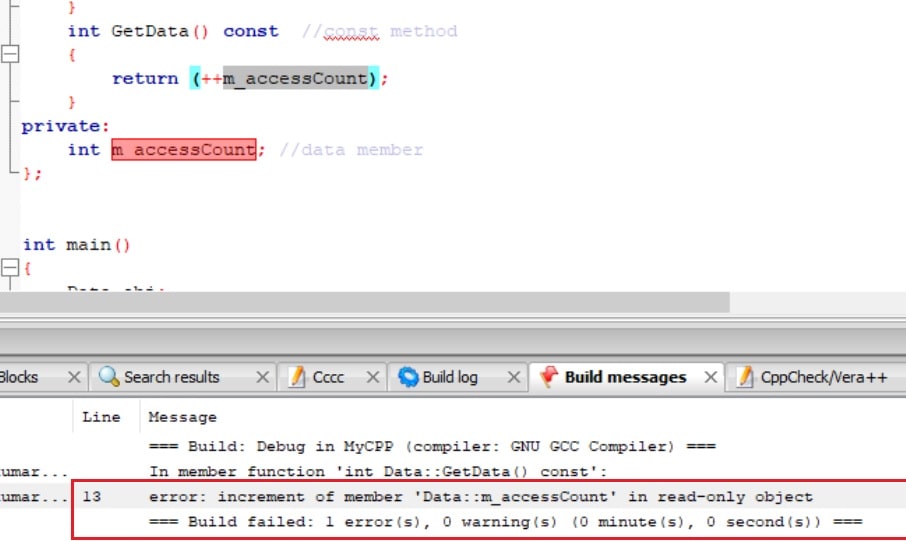
But sometimes we need to modify one or more data members of class/struct through the const method by preventing to modify other data members. This task can be easily performed by using the mutable keyword.
The mutable specifier on a class data member nullifies a const specifier applied to the containing class/struct object and permits modification of the mutable class member even though the rest of the object is const.
Let’s consider the same above discussed example but I am using a mutable keyword with m_accessCount.
#include <iostream>
using namespace std;


class Data
{
public:
    Data():m_accessCount(0)
    {
    }
    int GetData() const  //const method
    {
        return (++m_accessCount);
    }
private:
    mutable int m_accessCount; //data member with mutable
};


int main()
{
    Data obj;

    cout << obj.GetData()<<endl;

    return 0;
}
Output: 1
What will happens if try to modify a non-mutable data member with a const object?
Except that any class member declared mutable can be modified, any attempt to modify a const object during its lifetime results in undefined behavior. Let’s see some example codes to understand this statement.
Example 1:
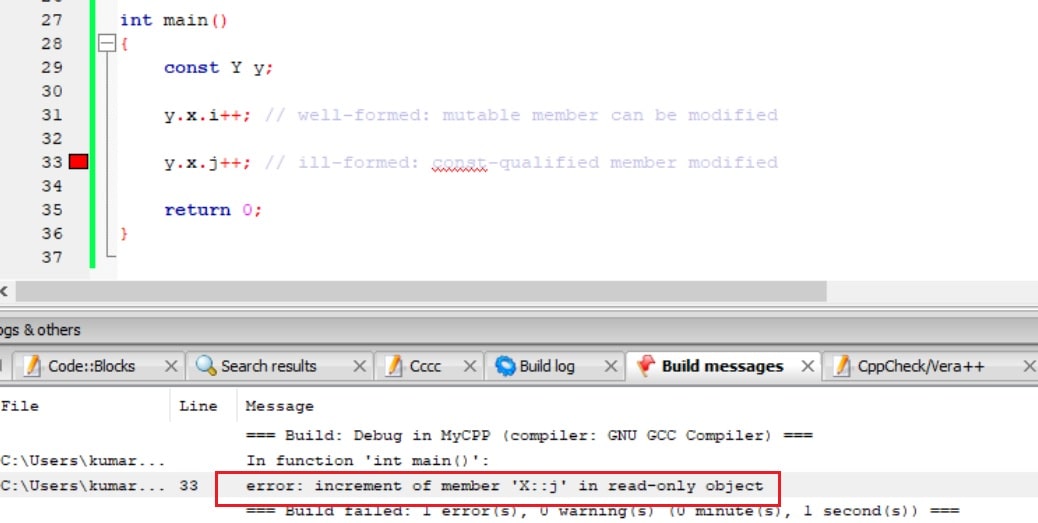
In the below example, const object “y” tries to modify the mutable and non-mutable data member. We will get here compiler error because we can not modify the non-mutable data member with const object.
#include <iostream>
using namespace std;


class X
{
public:
    X() {}
    //mutable member
    mutable int i;
    int j;
};


class Y
{
public:
    //object of x
    X x;
    Y():x()
    {

    }
};


int main()
{
    const Y y;

    y.x.i++; // well-formed: mutable member can be modified

    y.x.j++; // ill-formed: const-qualified member modified

    return 0;
}
Output:
Example 2:
In the below example forcefully we are trying to change the value of non-mutable data members through a const object. In that situation, we will get undefined behavior. Let’s see the example code,
#include <iostream>
using namespace std;


class X
{
public:
    X() {}
    //mutable member
    mutable int i;
    int j;
};


class Y
{
public:
    //object of x
    X x;
    Y():x()
    {

    }
};


int main()
{
    const Y y;

    Y* p = const_cast<Y*>(&y); // cast away const-ness of y

    p->x.i = 99; // well-formed: mutable member can be modified

    p->x.j = 99; // undefined: modifies a const subobject

    return 0;
}
Output:
The behavior of the code will be undefined.
Recommended Articles for you:
- Amazing list of Gifts for Programmers, You must.
- Introduction of reference in C++.
- Use of explicit keyword in C++.
- Best electronic kits for programmers.
- References and const in C++ with example programs.
- C++ Interview Questions with Answers.
- constructors in c++.
- Interview questions on constructor and destructor in C++.
- C++ Variables, Constants, and literals.
- Interview questions on the virtual keyword in C++.
- Interview Questions on Inheritance in C++.
- 100 embedded C interview Questions.
- Python Interview Questions with Answer.
- 100 c interview questions, your interviewer might ask.
- C Interview Questions for the experience