
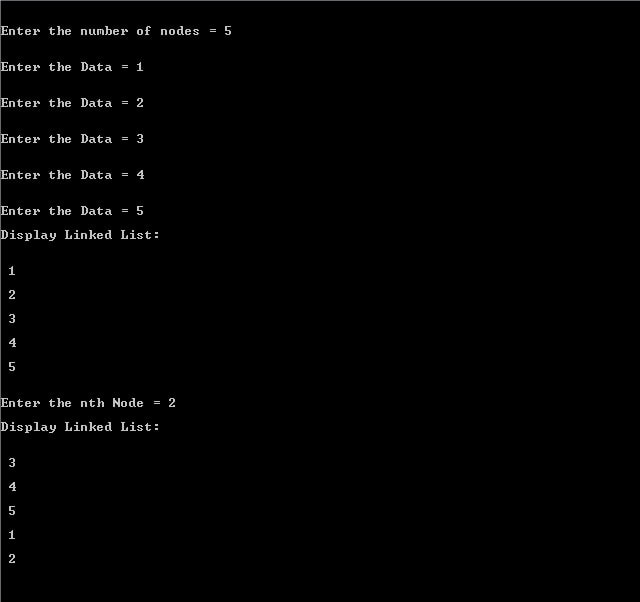
In this article, I will discuss how to rotate a linked list by its n node. That means if an existing linked list is 1->2->3->4->5 and a user-entered 2 then the linked list should be modified to 3->4->5->1->2.
Note: The value of n should be less than the length of the linked-list.
Steps to rotate a single linked list
- Traverse the linked-list by n nodes.
- Keep nth node in TmpNode.
- After that traverse, traverse the linked-list till the end and assign the address of the first node to the last node.
- Assign address of (n+1)node to the head (start) pointer.
- Point nth node next to NULL.
Code to rotate linked-list
This code rotates the linked list as per the user’s choice.
/* Function to rotate linked list by n nodes */
void RotateALinkedList(NodePointer *pHead, int iNode)
{

    int iCount = 0;
    NodePointer Current = *pHead;
    NodePointer TmpNode =NULL;

    //Get the position of nth node
    for(iCount = 1 ; ((iCount < iNode) && (Current!=NULL)) ; iCount++)
    {
        Current = Current->pNextNode;
    }

    if(Current == NULL)
    {
        return;
    }
    else
    {
        //nth Node
        TmpNode = Current;
    }

    //Get the last node
    while (Current->pNextNode != NULL)
    {
        Current  = Current->pNextNode;
    }

    //Assign the address of first node to the last node
    Current->pNextNode =  *pHead;

    //Now Last node become first node
    *pHead = TmpNode->pNextNode;

    // Current->pNextNode = RotateNode;
    TmpNode->pNextNode = NULL;
}
If you want to learn more about the c language, here 10 Free days (up to 200 minutes) C video course for you.
Your free trial is waiting
Driver program to rotate the linked list
In this driver source code user create a linked list as per the choice. After the creation of the linked list, it asked the user to enter their choice to rotate the linked list.
#include<stdio.h>
#include<stdlib.h>


// Creating Node
struct Node
{
    int iData;
    struct Node *pNextNode;
};


// Define the new type Node type and Node pointer
typedef  struct Node  NodeType, * NodePointer;


/* Function to rotate linked list by n nodes */
void RotateALinkedList(NodePointer *pHead, int iNode)
{
    int iCount = 0;
    NodePointer Current = *pHead;
    NodePointer TmpNode =NULL;

    //Get the position of nth node
    for(iCount = 1 ; ((iCount < iNode) && (Current!=NULL)) ; iCount++)
    {
        Current = Current->pNextNode;
    }

    if(Current == NULL)
    {
        return;
    }
    else
    {
        //nth Node
        TmpNode = Current;
    }

    //Get the last node
    while (Current->pNextNode != NULL)
    {
        Current  = Current->pNextNode;
    }

    //Assign the address of first node to the last node
    Current->pNextNode =  *pHead;

    //Now Last node become first node
    *pHead = TmpNode->pNextNode;

    // Current->pNextNode = RotateNode;
    TmpNode->pNextNode = NULL;
}


/* Paas the reference of the head pointer of a list and
   an integer data. This function use to add the node at the End*/
int InsertNodeAtEnd(NodePointer * pHead, int iUserData)
{
    int iRetValue = -1;

    NodePointer pLastNode = NULL;
    NodePointer pNewNode = NULL;

    //Give the Address of first Node
    pLastNode  = *pHead;

    // Call malloc to allocate memory in heap for the new node
    pNewNode = malloc(sizeof(NodeType));

    if( pNewNode != NULL) //Check allocated memory
    {
        pNewNode->iData = iUserData; //put the desire Data

        pNewNode->pNextNode  = NULL; //Give the Address of first Node

        iRetValue = 0; // Update the return value

    }
    // If there is no node in beginning
    if(pLastNode == NULL)
    {
        *pHead = pNewNode;
    }
    else
    {
        // Find the address of last node
        while( pLastNode ->pNextNode != NULL)
        {
            pLastNode  = pLastNode ->pNextNode;
        }

        // Assign last node address
        pLastNode ->pNextNode = pNewNode;

    }

    return iRetValue;
}


/* Paas the reference of the head pointer of a list. This function use
to free the all allocated memory*/
void FreeAllocatedMemory(NodePointer  *pHead)
{
    NodePointer   pTmpNode = NULL;
    NodePointer   pFirstNode = NULL;
    //Assign  the Address of first node
    pFirstNode  = *pHead;

    /*check if pFirstNode is NULL, then now list is empty,
    so assign NULL to head and return.*/
    while (pFirstNode  != NULL)
    {
        /*Save the pFirstNode in a pTmpNode node pointer*/

        pTmpNode = pFirstNode  ;

        /*Assign the address of next on your list*/
        pFirstNode  = pFirstNode->pNextNode;

        //Free the allocated memory
        free(pTmpNode );
    }
    //Assign NULL to the head pointer
    *pHead = NULL;

}


// This function use to prints the data of the list from the beginning
//to the given list.
void PrintTheList(NodePointer pNode)
{
    //Clear the screen

    printf("\nDisplay Linked List: \n\n");
    while (pNode != NULL)
    {
        printf("\n %d\n",pNode->iData);
        pNode = pNode->pNextNode;
    }

    printf("\n\n");

}

//Create a number of nodes
int CreateLinkedList(NodePointer *pHead, int iNumberofNode)
{
    int iData = 0;
    int iRetValue = -1;
    int iCount = 0;
    NodePointer pNewNode = NULL;

    for(iCount =0; iCount < iNumberofNode; iCount++)
    {
        /*Enter desire data*/
        printf("\n\nEnter the Data = ");
        scanf("%d",&iData);

        if((*pHead) == NULL)
        {
            // Call malloc to allocate memory in heap for the first node
            pNewNode = malloc(sizeof(NodeType));
            if( pNewNode != NULL) //Check allocated memory
            {
                pNewNode->iData = iData; //put the desire Data

                pNewNode->pNextNode  = NULL; //Give the Address of first Node

                *pHead = pNewNode; /*Assign the address of
                              first node to the head pointer*/

                iRetValue = 0; // Update the return value

            }
        }
        else
        {
            //Add the Node at the End
            iRetValue = InsertNodeAtEnd(pHead,iData);

        }
    }

    return iRetValue;
}


/* Driver program to test above functions*/
int main(void)
{
    int iNumberNode =0;
    int iData = 0;


    /*Start with the empty list */
    NodePointer head = NULL;


    printf("\n\nEnter the number of nodes = ");
    scanf("%d",&iNumberNode);

    //Create a linked list of three node
    CreateLinkedList(&head,iNumberNode);

    /*
    pHead
    |
    |
    |
    v
    ---------     ---------     ---------    ---------     ---------
    | 1 | --+--->| 2 |  --+--->| 3 | --|---->| 4 |  --+--->| 5 | 0 |
    ---------     ---------     ---------    ---------     ---------

    */


    //Print the created node
    PrintTheList(head);
    printf("Enter the nth Node = ");
    scanf("%d",&iData);

    //Check the user choice
    if( iData <= iNumberNode)
    {
        RotateALinkedList(&head,iData);
        //Print the created node
        PrintTheList(head);
    }
    else
    {
        printf("\n\nPlease Enter Valid nth node\n");
    }


    //Free the allocated memory
    FreeAllocatedMemory(&head);

    return 0;
}
OutPut:
Recommended Post
- Introduction to Linked List.
- Rotate a Linked List.
- Linked List Insertion.
- Delete a Linked List node.
- Generic Linked List in C
- Write a function to reverse a linked list
- File handling in C.
- How to create dynamic array in C?
- 15 Common mistakes with memory allocation.
- How to access 2d array in C?
- A brief description of the pointer in C.
- How to use function pointer in C?
- How to use the structure of function pointer in c language?
- Replace the nested switch case using an array and function pointer.
- Implement state machine in C.
- Function pointer in structure.
- Pointer Arithmetic in C.
- Memory Layout in C.
- Union in C, A detailed Guide.
- typedef vs #define in C.
- Macro in C, with example code.