In my previous article, I explained the basic concepts of a linked list along with its advantages and disadvantages. In this article, I will show you how to insert a new node into an existing linked list.
Earlier, I shared an example where I created a linked list with four nodes. While that example was useful for understanding how to build a linked list, it wasn’t generic or reusable.
In this article, I’ll create a generic function to insert a new node into an existing linked list, allowing flexibility based on the user’s requirement.
There are three common ways to insert a new node in a linked list:
-
At the beginning of the list
-
After a specific node in the list
-
At the end of the list
Insert a Node at the Beginning of the Linked List in C:
To insert a new node at the beginning of a linked list, follow these simple steps:
🟩👉 Allocate memory for the new node using malloc():
NodePointer pNewNode = malloc(sizeof(NodeType));
🟩👉 Store the data in the newly created node, if memory allocation is successful:
if (pNewNode != NULL)
{
    pNewNode->iData = Value;
}
🟩👉 Link the new node to the existing list by setting its pNextNode pointer to the current head node.
if (pNewNode != NULL)
{
    pNewNode->pNextNode = head;
}
🟩👉 Update the head pointer to point to the new node:
Head = pNewNode;
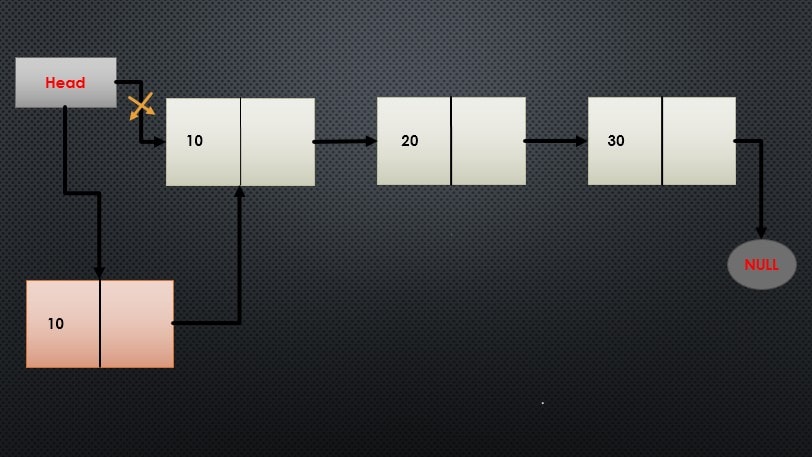
Below is a sample implementation of a function that inserts a new node at the beginning of the linked list:
/**
 * @brief Insert a node at the beginning of the list.
 *
 * @param[in,out] pHead Pointer to head pointer.
 * @param[in] value Data to insert.
 *
 * @return 0 on success, -1 on failure.
 */
int InsertAtBeginning(NodePtr* pHead, int value)
{
    int status = -1;
    NodePtr newNode = (NodePtr)malloc(sizeof(Node));

    if (newNode != NULL)
    {
        newNode->data = value;
        newNode->next = *pHead;
        *pHead = newNode;
        status = 0;
    }

    return status;
}
Insert a new node after a node:
In a linked list, data is not stored in contiguous memory, so to reach a specific node, we must always start traversing from the head. Below are the steps to insert a new node after a given position in the linked list:
1. Initialize a temporary pointer and assign it the address of the first node (i.e., the head of the list):
NodePointer pTmpNode = head;
2. Traverse the list to reach the node after which you want to insert the new node:
unsigned int count = 1;

// Traverse to the specified position
while ((tempNode != NULL) && (count < position))
{
    tempNode = tempNode->pNextNode;
    count++;
}
3. Verify the existence of the target node (pTmpNode). If it exists, allocate memory for the new node.
if (pTmpNode != NULL)
{
    NodePointer pNewNode = malloc(sizeof(NodeType));

    // Here your code
}
4. Store the data in the newly created node, if memory allocation was successful:
if(pNewNode != NULL)
{
    pNewNode->iData = Value;
}
5. Link the new node by setting its pNextNode to point to the next node of the temporary node:
pNewNode->pNextNode = pTmpNode->pNextNode;
6. Update the temporary node’s link to point to the newly created node:
pTmpNode->pNextNode = pNewNode;
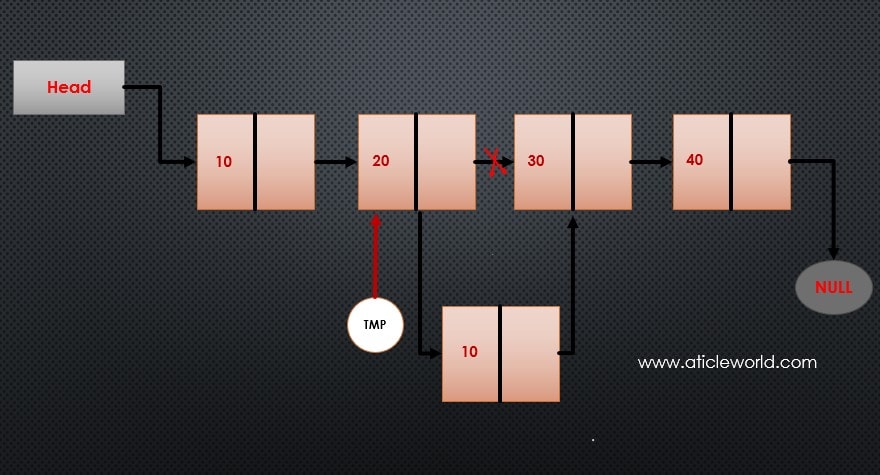
/*
 * Inserts a new node with the given data after the specified position in the linked list.
 *
 * @param pHead       Pointer to the head pointer of the linked list
 * @param value    Data to store in the new node
 * @param position    Position after which the new node should be inserted (1-based index)
 *
 * @return            0 on success, -1 on failure
 */
int InsertNodeAfter(NodePointer *pHead, int value, unsigned int position)
{
    int retValue = -1;
    unsigned int count = 1;
    NodePointer tempNode = NULL;
    NodePointer newNode = NULL;

    // Validate head pointer
    if ((pHead != NULL) && (*pHead != NULL))
    {
        tempNode = *pHead;

        // Traverse to the specified position
        while (count < position && tempNode != NULL)
        {
            tempNode = tempNode->pNextNode;
            count++;
        }

        if (tempNode != NULL)
        {
            // Allocate memory for the new node
            newNode = malloc(sizeof(NodeType));

            if (newNode != NULL)
            {
                // Set node data and links
                newNode->iData = value;
                newNode->pNextNode = tempNode->pNextNode;
                tempNode->pNextNode = newNode;

                retValue = 0;  // success
            }
            else
            {
                printf("Memory allocation failed.\n");
            }
        }
        else
        {
            printf("Invalid position: exceeds list length.\n");
        }
    }
    else
    {
        printf("Invalid head pointer.\n");
    }

    return retValue;
}
Insert a Node at the End of the Linked List:
Appending a new node to the end of a linked list is a common operation. Below are the steps to insert a node at the end of an existing linked list:
🔧 Steps to Append a Node:
1. Create a temporary pointer and assign it the address of the first node using the head pointer.
NodePointer pTmpNode = head;
2. Traverse the list to reach the last node (where pNextNode is NULL).
while (pTmpNode->pNextNode != NULL)
{
    pTmpNode = pTmpNode->pNextNode;
}
3. Allocate memory dynamically for the new node.
NodePointer pNewNode = malloc(sizeof(NodeType));
4. If memory allocation is successful, assign the user-defined value to the iData field.
if (pNewNode != NULL)
{
    pNewNode->iData = value;  // replace `value` with actual data
}
5. Link the new node to the list by assigning its address to the pNextNode of the last node.
pTmpNode->pNextNode = pNewNode;
6. Mark the new node as the last node by setting its pNextNode to NULL.
pNewNode->pNextNode = NULL;
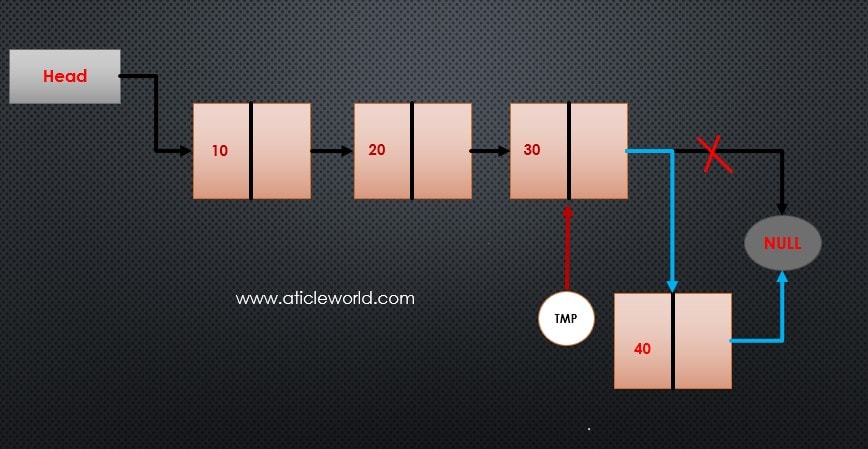
Note: Don’t forget to free the allocated memory.
Free the Allocated memory
/* Paas the reference of the head pointer of a list. This function use
to free the all allocated memory*/
void FreeAllocatedMemory(NodePointer  *pHead)
{
    NodePointer   pTmpNode = NULL;
    NodePointer   pFirstNode = NULL;
    //Assign  the Address of first node
    pFirstNode  = *pHead;

    /*check if pFirstNode is NULL, then now list is empty,
    so assign NULL to head and return.*/
    while (pFirstNode  != NULL)
    {
        /*Save the pFirstNode in a pTmpNode node pointer*/

        pTmpNode = pFirstNode  ;

        /*Assign the address of next on your list*/
        pFirstNode  = pFirstNode->pNextNode;

        //Free the allocated memory
        free(pTmpNode );
    }
    //Assign NULL to the head pointer
    *pHead = NULL;

}
In below program, I am creating a linked list where I am adding the node at the beginning, end and at any position of the linked list.
// A simple C program to introduce a linked list
#include<stdio.h>
#include<stdlib.h>


// Creating Node
struct Node
{
    /*Data field*/
    int iData;
    /*Node Pointer*/
    struct Node *pNextNode;
};


// Define the new type Node type and Node pointer
typedef  struct Node  NodeType, * NodePointer;


/* Paas the reference of the head pointer of a list and
   an integer data. This function use to add the node at the beginning*/
int InsertNodeAtBeginning(NodePointer * pHead, int iUserData)
{
    int iRetValue = -1;

    // Call malloc to allocate memory in heap for the new node
    NodePointer pNewNode = malloc(sizeof(NodeType));

    if( pNewNode != NULL) //Check allocated memory
    {
        pNewNode->iData = iUserData; //put the desire Data

        pNewNode->pNextNode  = *pHead; //Give the Address of first Node

        *pHead = pNewNode; // Assign the Address of New Node to Head

        iRetValue = 0; // Update the return value

    }
    return iRetValue;
}


/* Paas the reference of the tempnode pointer of a list and
   an integer data*/
int InsertNodeAfterNode(NodePointer * pHead, int iUserData,unsigned int iPosition)
{
    int iRetValue = -1;
    NodePointer pTmpNode = NULL;
    unsigned int iCount = 0;

    //Give the Address of first Node
    pTmpNode  = *pHead;

    for( iCount = 1; ((iCount < iPosition) && (pTmpNode!= NULL)) ; iCount++)
    {
        pTmpNode  = pTmpNode ->pNextNode;
    }

    /* check the pTmpNode*/
    if (pTmpNode == NULL)
    {
        printf("Enter Position is Invalid\n");
        return iRetValue;
    }
    else
    {
        /*  allocate memory for the new node */
        NodePointer pNewNode = malloc(sizeof(NodeType));

        if( pNewNode != NULL)
        {
            //put in the data
            pNewNode->iData = iUserData;
            //Assign the address of next node to the new node
            pNewNode->pNextNode = pTmpNode->pNextNode;

            // Assign the address of new node to the previous node
            pTmpNode->pNextNode = pNewNode;

            iRetValue = 0;
        }

    }


    return iRetValue;
}


/* Paas the reference of the head pointer of a list and
   an integer data. This function use to add the node at the End*/
int InsertNodeAtEnd(NodePointer * pHead, int iUserData)
{
    int iRetValue = -1;

    NodePointer pLastNode = NULL;
    NodePointer pNewNode = NULL;

    //Give the Address of first Node
    pLastNode  = *pHead;

    // Call malloc to allocate memory in heap for the new node
    pNewNode = malloc(sizeof(NodeType));

    if( pNewNode != NULL) //Check allocated memory
    {
        pNewNode->iData = iUserData; //put the desire Data

        pNewNode->pNextNode  = NULL; //Give the Address of first Node

        iRetValue = 0; // Update the return value

    }
    // If there is no node in beginning
    if(pLastNode == NULL)
    {
        *pHead = pNewNode;
    }
    else
    {
        // Find the address of last node
        while( pLastNode ->pNextNode != NULL)
        {
            pLastNode  = pLastNode ->pNextNode;
        }

        // Assign last node address
        pLastNode ->pNextNode = pNewNode;

    }

    return iRetValue;
}


/* Paas the reference of the head pointer of a list. This function use
to free the all allocated memory*/
void FreeAllocatedMemory(NodePointer  *pHead)
{
    NodePointer   pTmpNode = NULL;
    NodePointer   pFirstNode = NULL;
    //Assign  the Address of first node
    pFirstNode  = *pHead;

    /*check if pFirstNode is NULL, then now list is empty,
    so assign NULL to head and return.*/
    while (pFirstNode  != NULL)
    {
        /*Save the pFirstNode in a pTmpNode node pointer*/

        pTmpNode = pFirstNode  ;

        /*Assign the address of next on your list*/
        pFirstNode  = pFirstNode->pNextNode;

        //Free the allocated memory
        free(pTmpNode );
    }
    //Assign NULL to the head pointer
    *pHead = NULL;

}


// This function use to prints the data of the list from the begning
//to the given list.

void PrintTheList(NodePointer pNode)
{
    //Clear the screen

    printf("\nLinked List is: \n\n");
    while (pNode != NULL)
    {
        printf("\n %d\n\n",pNode->iData);
        pNode = pNode->pNextNode;
    }

    system("pause");
}


//Create a linked list of certain number of nodes
int CreateLinkedList(NodePointer *pHead, int iNumberofNode)
{
    int iData = 0;
    int iRetValue = -1;
    int iCount = 0;

    for(iCount =0; iCount < iNumberofNode; iCount++)
    {
        /*Enter desire data*/
        printf("\n\nEnter the Data = ");
        scanf("%d",&iData);

        if((*pHead) == NULL)
        {
            //Create First Node
            iRetValue = InsertNodeAtBeginning(pHead,iData);
        }
        else
        {
            //Add the Node at the End
            iRetValue = InsertNodeAtEnd(pHead,iData);

        }
    }

    return iRetValue;
}


/* Driver program to test above functions*/
int main(void)
{
    int iChoice = 0;
    int iNumberNode =0;
    int iData = 0;
    int iPosition =0;

    /*Start with the empty list */
    NodePointer head = NULL;


    while(1)
    {


        //Select the Choice as per the requirements
        printf("\n\n\
         1: Create the Linked List\n\
         2: Display The Linked List\n\
         3: Insert Node at the begninig of Linked list\n\
         4: Insert Node at the End of Linked List \n\
         5: insert Node After a Node \n\
         6: terminatethe process \n\n\n");


        printf("\n\nenter your choice = ");
        scanf("%d",&iChoice);
        switch(iChoice)
        {
        case 1:
            printf("\n\nEnter the number of nodes = ");
            scanf("%d",&iNumberNode);
            CreateLinkedList(&head,iNumberNode);
            break;

        case 2:
            PrintTheList(head);
            break;

        case 3:
            printf("\n\nEnter the desired data = ");
            scanf("%d",&iData);
            InsertNodeAtBeginning(&head,iData);
            break;

        case 4:
            printf("\n\nEnter the desired data = ");
            scanf("%d",&iData);
            InsertNodeAtEnd(&head,iData);
            break;

        case 5:
            printf("\n\nEnter the Position = ");
            scanf("%d",&iPosition);
            printf("\nEnter the desired data = ");
            scanf("%d",&iData);
            InsertNodeAfterNode(&head,iData,iPosition);
            break;

        case 6:
            printf("\n\nFree the all Allocated memory\n");

            FreeAllocatedMemory(&head);

            printf("\n\nprocess is terminated\n ");
            exit(1);
            break;


        }

    }


    return 0;
}
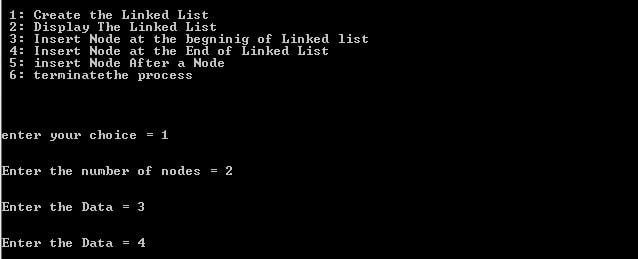
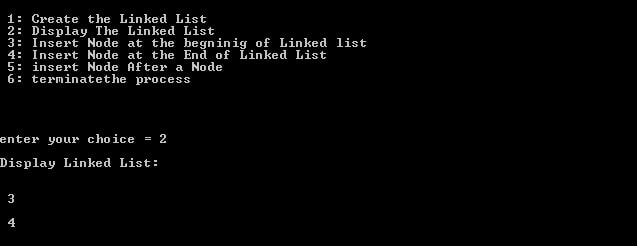
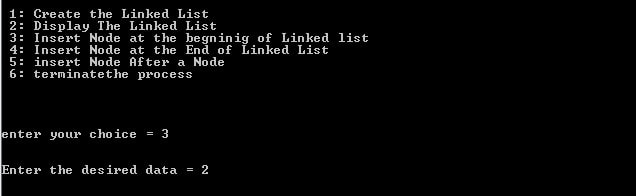
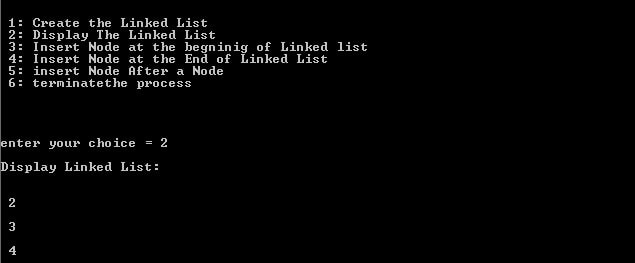
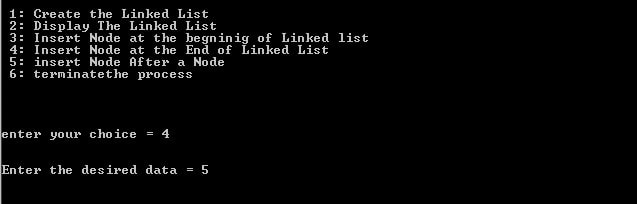
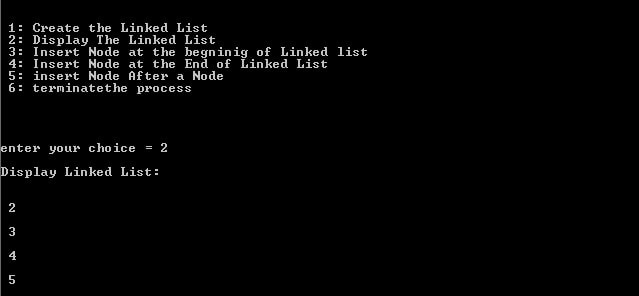
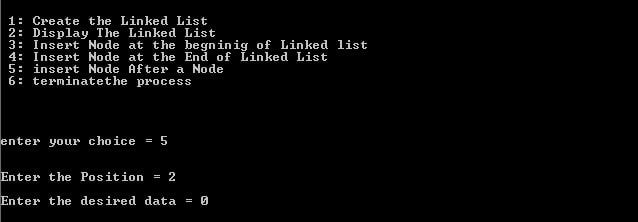
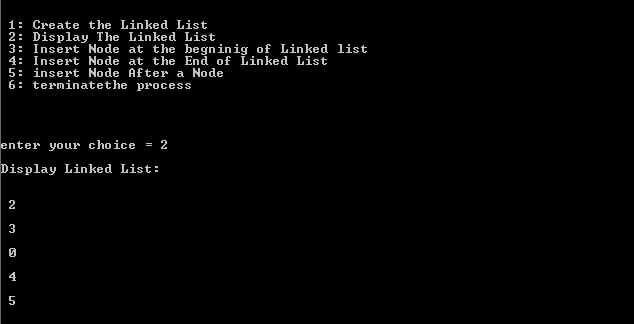
OutPut:
1. Create a linked-list using two nodes.